

Prevent This: The Text That Costs You Everything
That friendly "wrong number" text could be the start of a scam that has stolen $75 billion worldwide. Here's a simple guide to the most common text-based financial scams and how to spot them.

What Happened?
It starts with a text.
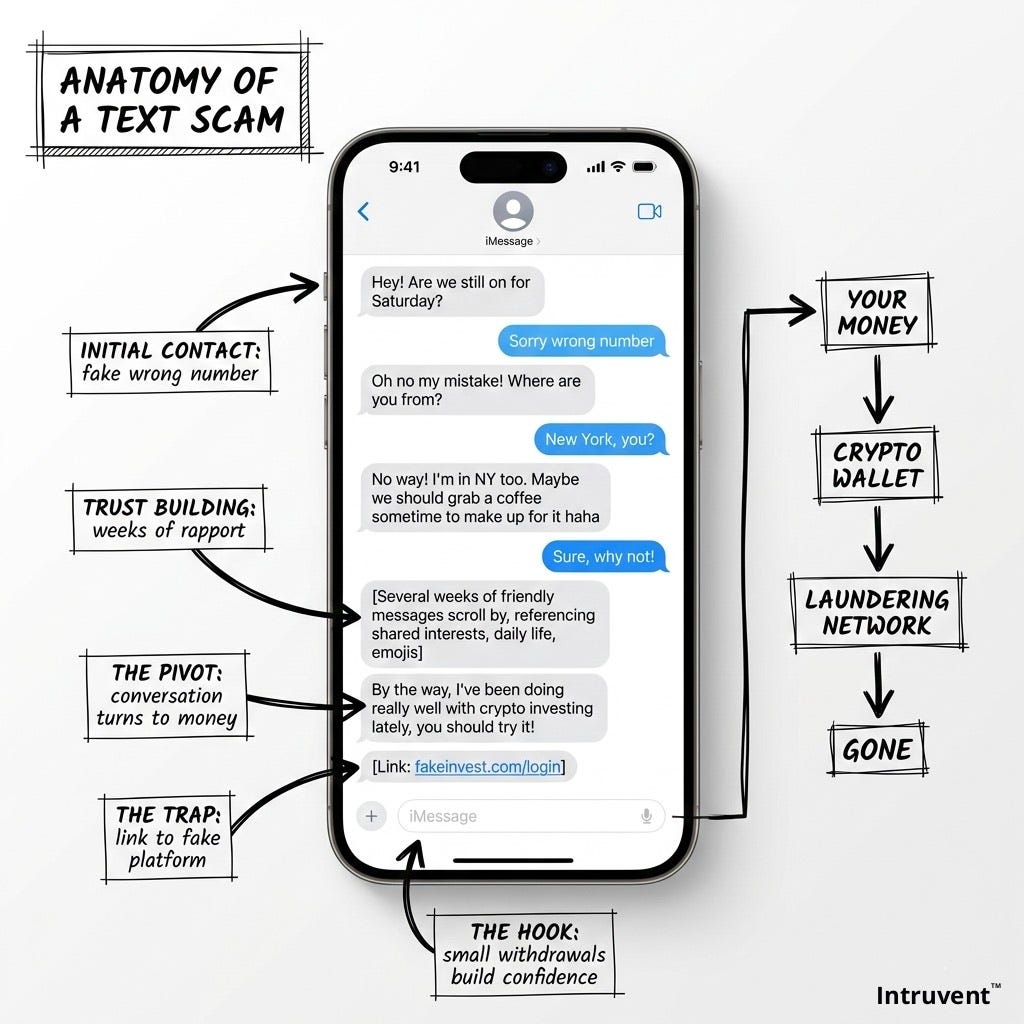
“Hey! Are we still on for dinner Saturday?” You don’t recognize the number. You reply, “Sorry, wrong number.” The person responds: “Oh no, my mistake! Well, have a great weekend!” Then a few minutes later: “You seem nice though. I’m Sarah. Where are you from?”
Seems harmless, right? Maybe even a little flattering. But that text was sent to hundreds of people at the same time. And the person on the other end is following a script designed to do one thing: take your money.
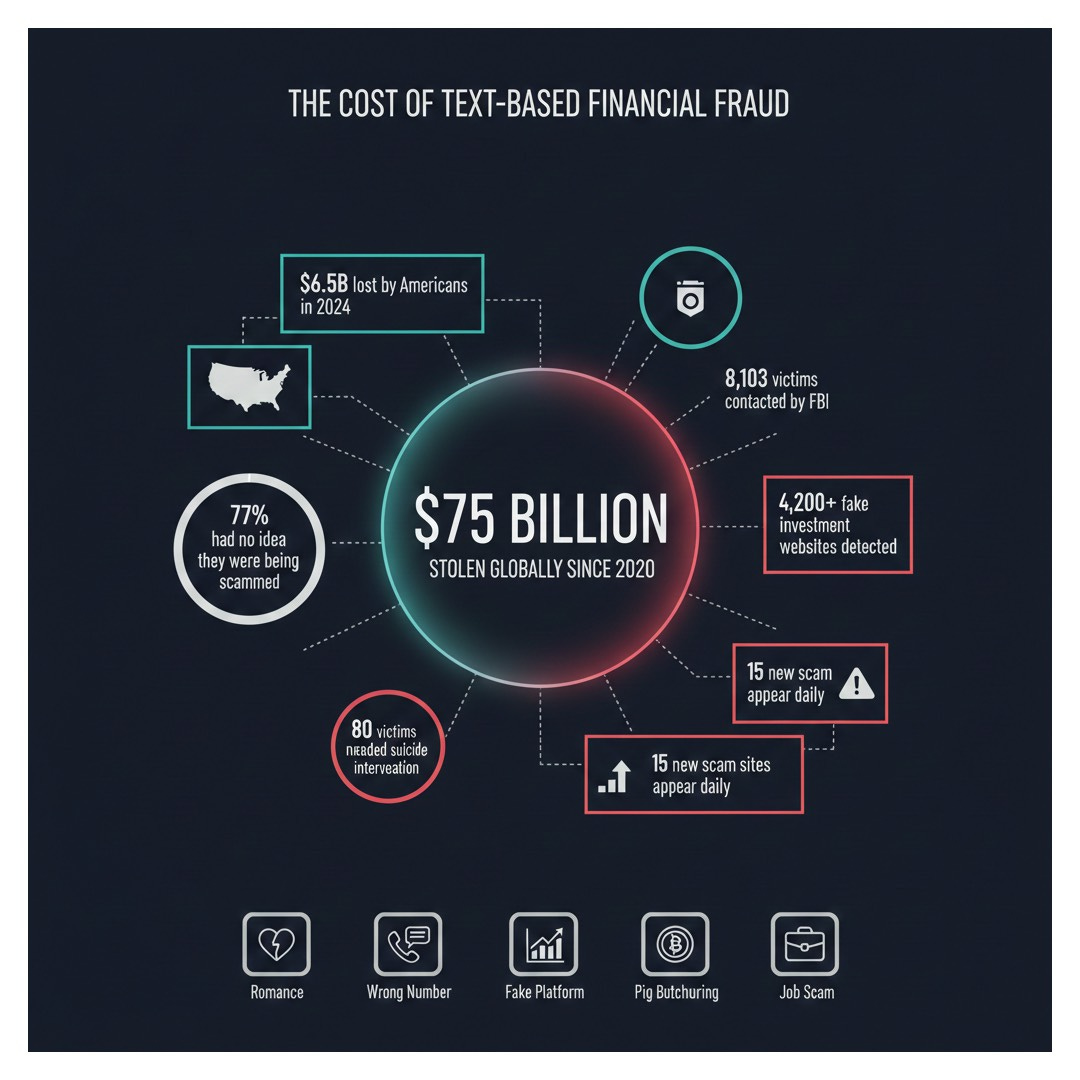
Americans lost $12.5 billion to fraud in 2024, according to the Federal Trade Commission. Investment fraud was the biggest piece of that, with $5.7 billion in losses. The FBI reported that cryptocurrency scams alone cost Americans $6.5 billion last year. Globally, researchers at the University of Texas traced over $75 billion flowing through fake investment networks between 2020 and 2024.
These scams arrive by text, dating apps, social media, and email. They come in different flavors, but they all follow the same basic recipe: build trust, then steal money.
Let’s walk through the most common ones.
The Scams You Need to Know
The Romance Scam (The Original)
This is the oldest version, and it still works. Someone reaches out on a dating app, Facebook, or Instagram. They’re attractive, successful, and very interested in you. They’re also conveniently far away. Military deployment. Working overseas. Living in another state. There’s always a reason they can’t meet in person.
Over weeks or months, they build a relationship with you. Daily texts. Phone calls. Maybe even gifts. Then the ask comes. A medical emergency. A plane ticket to come visit you. A business deal that fell through. They need money, and they’ll pay you back as soon as they can.
Spoiler: they won’t. Because the person in those profile photos has no idea their pictures are being used by a scammer on the other side of the world.
The FTC says nearly 64,000 people reported romance scams in 2023, with $1.4 billion in losses. The real numbers are higher because most people are too embarrassed to report it.
The “Wrong Number” Friendship Scam
This is the one that’s exploding right now. You get a text that seems like it was meant for someone else. “Hi Mike, are we still meeting at 11?” Your name isn’t Mike. You say so. And suddenly you have a new friend.
The conversation is casual at first. Over days or weeks, the person shares stories about their life, asks about yours, and builds a real sense of connection. Then the conversation shifts to money. They mention that they’ve been doing really well with investing. They show you screenshots of their returns. They offer to help you get started.
The FBI has warned about this specific approach, noting that scammers send these “wrong number” texts in bulk. They’re counting on your friendliness to get a conversation going. Once they have your attention, they steer you toward a fake investment platform.
The Fake Investment Platform
This is where the real damage happens. The scammer (or your new “friend” from the wrong number text) points you to an investment platform. It looks professional. Real-time charts. A working dashboard. Customer support chat. It looks like Fidelity or Coinbase.
You deposit a small amount. It grows. You might even make a small withdrawal, and the money actually shows up in your bank account. Everything checks out.
So you invest more. The dashboard shows your balance climbing. You tell yourself this is working. You invest your savings. Maybe you take out a loan. Maybe you borrow from family.
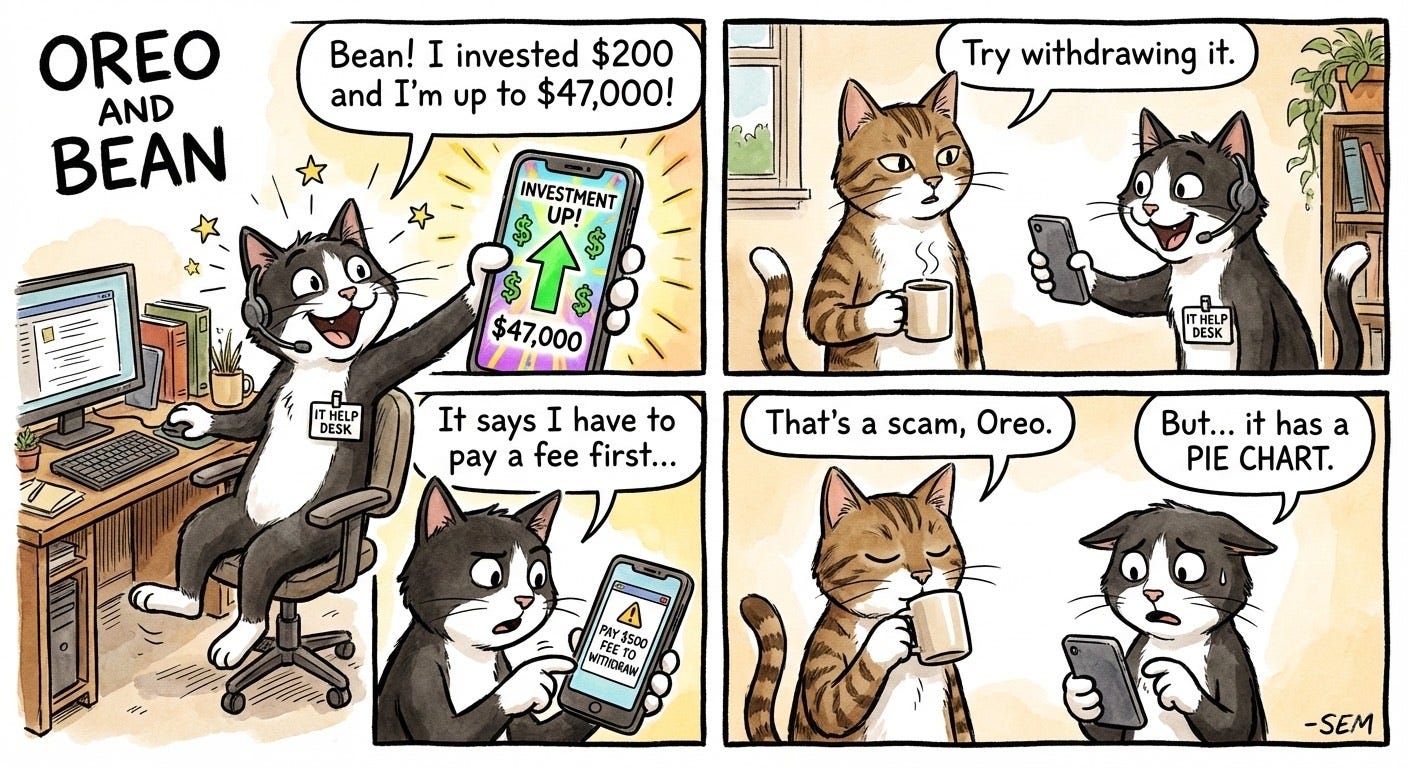
Then you try to make a large withdrawal. Suddenly there’s a “tax” you need to pay first. Or a “processing fee.” Or a “verification deposit.” Each new requirement costs more money. And your balance on the platform becomes impossible to access.
The platform was fake the entire time. The charts were fake. The returns were fake. The money you “withdrew” early on was your own deposit being returned to build your confidence. Security researchers at CTM360 found over 4,200 of these fraudulent websites operating in the past year, with about 15 new ones appearing every single day.
The “Pig Butchering” Combo
This is the most destructive version because it combines everything above. The name comes from the scammers themselves. The victim is the “pig.” The weeks of relationship building are the “fattening.” And the moment they take your money is the “butchering.”
It usually starts with a wrong number text or a dating app connection. The scammer builds trust over weeks. Then they introduce a fake crypto trading platform. The victim invests small, sees “returns,” and invests bigger. By the time they realize the platform is fake, they’ve lost everything.
A Kansas bank president fell for this scam and ended up embezzling $47 million from his own bank trying to recover his losses. The bank collapsed. He got 24 years in prison.
The FBI’s Operation Level Up has contacted over 8,000 victims of these scams. 77% of them had no idea they were being scammed when the FBI reached out. And 80 victims needed suicide intervention after losing everything they had.
The “Pay to Get Paid” Job Scam
This one targets people looking for work. You see a job posting for easy online tasks. Review products. Like videos. Rate apps. You apply and get “hired” immediately. You start doing tasks and see money adding up in your account.
Then you’re told you need to “invest” to unlock higher-paying tasks. Or you need to pay a fee to withdraw your earnings. The small payments you received at the beginning were bait. The real goal is to get you to send money for tasks that will never pay out.
The Toll Road / Shipping / Parking Scam
These are the quick-hit versions. You get a text saying you have an unpaid toll, a package that can’t be delivered, or an overdue parking ticket. There’s a link to pay. The link goes to a fake website that steals your credit card information or installs malware on your phone.
These scams increased 900% in 2025, according to McAfee. They work because the amounts are small enough that people pay without thinking twice.
How Do These Scams Actually Work Behind the Scenes?
Most of these operations run out of large compounds in Southeast Asia. The United Nations estimates that over 200,000 people are working in these scam centers, and many of them are trafficking victims forced to do this work under threat of violence.
The operations are sophisticated. Scammers follow detailed scripts. They work in shifts so “your friend” is always available to chat. They use AI to generate convincing profile photos. Some operations now sell “Pig Butchering as a Service” kits that include fake platform templates, stolen identities, and step-by-step playbooks for manipulating victims.
The money moves fast. Victims are told to pay with cryptocurrency, wire transfers, or gift cards because those are the hardest to trace and recover. Once the money is sent, it’s typically laundered through multiple crypto wallets and cashed out within hours.
What Can You Do?
Don’t reply to texts from numbers you don’t know. This is the simplest and most effective defense. That “wrong number” message is almost certainly not a wrong number. Delete it. Block the sender. Move on.
Never invest based on an online relationship. If someone you’ve never met in person is talking to you about money, investing, or crypto, it’s a scam. Full stop. It doesn’t matter how long you’ve been talking or how real the relationship feels.
Remember that guaranteed returns don’t exist. The stock market averages about 10% per year with plenty of bad years mixed in. Any platform promising 1% daily, 30% monthly, or “guaranteed” profits is lying. If it sounds too good to be true, it is.
Check before you invest. Look up any investment platform on investor.gov (SEC) or brokercheck.finra.org (FINRA). If the platform isn’t registered with financial regulators, walk away.
Watch for withdrawal problems. The moment any platform asks you to pay a fee, tax, or deposit to access your own money, you’re being scammed. Real brokerages take fees from your balance. They never ask you to send more money to get your money out.
Talk to someone before you send money. Scammers isolate their victims on purpose. They tell you the opportunity is “exclusive” or ask you to keep it quiet. A real investment gets better when you ask questions. A scam falls apart. Talk to a family member, a friend, or a financial advisor before you commit any money.
If you think you’ve been scammed, act now. Stop all contact with the scammer. Stop sending money. Call your bank. Then file a report with the FBI at ic3.gov. The FBI’s Operation Level Up has saved victims over $500 million by catching scams before victims lost everything. The sooner you report, the better your chances.
The Bottom Line
These scams work because they target something deeply human. We want connection. We want to trust people. And we want to believe that a better financial future is within reach.
Scammers know that, and they exploit it. They’re patient. They’re persistent. And they’re running operations that have stolen more money than most people can comprehend.
But the defense is simple. Don’t reply to strangers. Don’t invest based on online relationships. Don’t trust platforms that promise guaranteed returns. And if something feels off, talk to someone you trust before you send a single dollar.
Your instincts are good. Trust them.
Research Sources: FBI IC3 2024 Annual Report, FBI Operation Level Up, FTC 2024 Consumer Fraud Data, Chainalysis 2026 Crypto Crime Report, CTM360 HYIP Risk Report, Infoblox PBaaS Report, University of Texas Blockchain Study (Griffin & Mei), McAfee 2025 Scam Retrospective, SEC Investor.gov, NASAA, AARP Fraud Watch Network
Last Updated: February 3, 2026
well written :)