

Prevent This: Social Media's Open Door. Part 1: The Ghost in Your Kid's Phone
Your kid's favorite "disappearing" photo app has 130 million teen users, a documented predator problem, and parental controls you've probably never heard of. Here's how to set it up more securely.

About this Series

Your kid's phone is a gateway to more than just their friends. It connects to your home network, your family's location data, and in some cases, your workplace systems. When a predator targets your teenager on Snapchat or a scammer tricks them into clicking a malicious link on Instagram, the threat doesn't stop at their device. It can pivot to your home security cameras, your work laptop on the same Wi-Fi, or your personal or financial information.
This “Social Media” series breaks down the most popular social platforms your kids are using, the specific risks each one presents, and the settings you need to lock down to protect them from both predators and cyber threat actors. This week we’ll start with Snapchat.
What Happened?
If you’re not on Snapchat yourself, here’s the short version: it’s a messaging app built around photos and short videos that disappear after viewing. It also offers Stories (24-hour visible content), augmented reality filters, real-time location sharing, and an AI chatbot. It launched in 2011, it’s owned by Snap Inc., and its official minimum age is 13.
Kids love it because it feels more private and lower-pressure than Instagram or TikTok. No public follower count, no permanent feed to curate, and disappearing messages make everything feel casual and off-the-record. For teenagers, it’s replaced texting as the place they make plans, joke around, and stay connected. According to Pew Research Center, roughly 130 million teens use it daily worldwide.
In January 2026, Snapchat settled a lawsuit with New Mexico accusing the platform of fueling addiction and mental health harm among minors, TechCrunch reported. Two days later, the company rolled out new parental controls. The timing wasn’t subtle.
The lawsuit was just the latest. In 2024, the New Mexico Department of Justice sent undercover agents posing as teenagers onto Snapchat. According to the state’s complaint, within minutes of creating a fake account for a 14-year-old, agents were flooded with predatory messages, including usernames that explicitly referenced child abuse. Internal Snap documents cited in the lawsuit revealed the company was receiving roughly 10,000 sextortion reports per month. Employees had been raising alarms for years, according to NPR’s reporting on the case.
Florida, Utah, Kansas, and other states have filed their own lawsuits. Over 600 cases naming Snap Inc. have been filed since 2022, according to court records. The consistent allegation across these suits: disappearing messages, minimal age verification, and algorithmic friend suggestions create an environment where predators thrive.
Despite this, Snapchat remains one of the most popular apps among American teenagers, according to Pew Research Center surveys. For many kids, leaving the platform means leaving their entire social circle.
Why Should You Care?
You probably can’t keep your teenager off Snapchat entirely, and a growing body of research suggests that banning social media outright tends to backfire. Studies published in Nature and JAMA Network Open point to a consistent finding: digital literacy and supervised engagement outperform prohibition. Bans push kids to unmonitored spaces, erode trust, and skip the part where teenagers learn to navigate digital life responsibly.
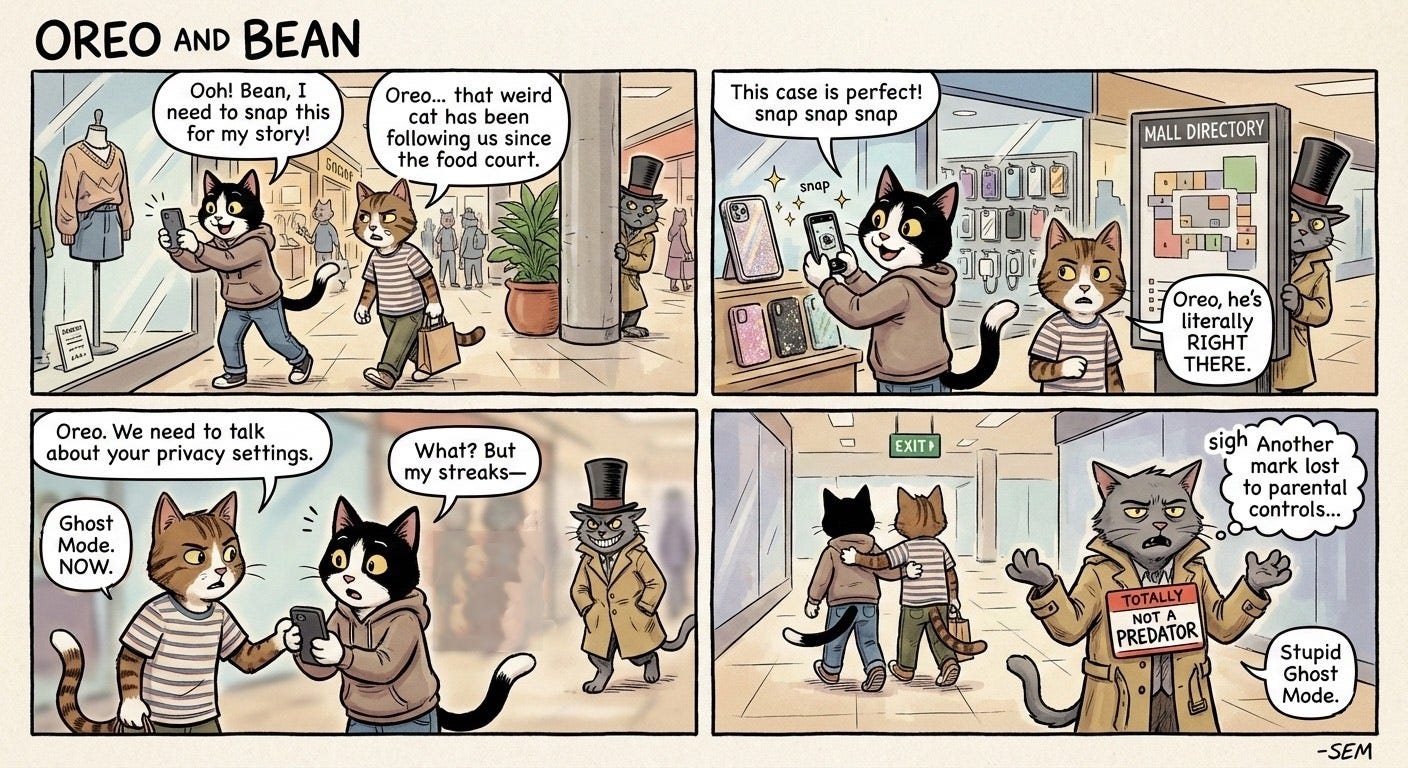
That said, “supervised” is doing a lot of heavy lifting in that sentence. Snapchat has specific, well-documented risks that parents need to understand.
Sextortion is surging. Nearly one in four Gen Z teens and young adults surveyed across six countries reported being victims of sextortion. Among minors who shared intimate images, 76% said they were lied to by the abuser, and 66% lost control of the material. The National Center for Missing and Exploited Children (NCMEC) is one of the premiere agencies in the US dedicated to helping protect children from predators. NCMEC received over 456,000 reports of online enticement in 2024. The FBI, DHS, and multiple state attorneys general have all flagged apps like Snapchat as a primary vector for this type of crime.
“Disappearing” messages create a false sense of safety. Teens think Snaps vanish, so there’s no risk. But screenshots happen. Screen recordings happen. Predators know this illusion makes kids more likely to share content they’d never put in a regular text.
Snap Map broadcasts your kid’s location. It can pinpoint a user down to a specific building. If your teen’s settings aren’t locked down, anyone on their friends list (including strangers accepted through Quick Add) can see exactly where they are.
Quick Add connects strangers to kids. This feature suggests new friends based on mutual connections and phone contacts. Safety researchers have identified it as one of the main ways adult predators access minors on the platform.
How Does This Work?
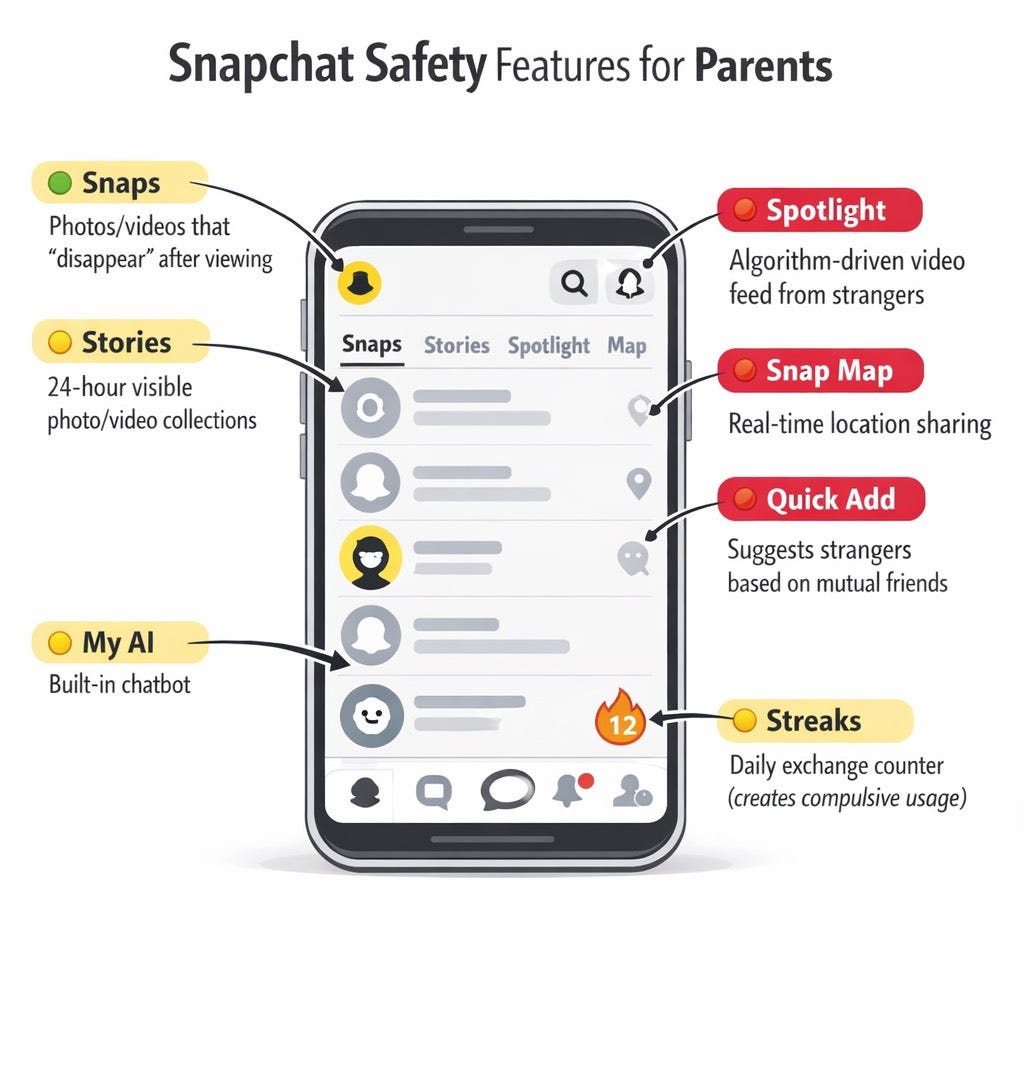
A quick guide to the features that matter most:
Snaps are photos or videos sent to friends. They disappear after viewing, usually within seconds. Recipients can replay once or screenshot (the sender gets notified of a screenshot, but that doesn’t prevent the capture).
Stories are Snap collections visible to friends (or the public, depending on settings) for 24 hours.
Spotlight is Snapchat’s short-form video feed, similar to TikTok. An algorithm recommends content based on engagement. This is where teens encounter content from strangers.
Snap Map shows friends’ real-time locations whenever they open the app, unless Ghost Mode is enabled.
Quick Add suggests new connections based on mutual friends, contacts, and communities. Safety advocates have pushed Snap to disable this for minors.
My AI is a built-in chatbot. Parents can disable it through Family Center.
Streaks track consecutive days two users have exchanged Snaps. Sounds harmless, but they create compulsive patterns. Teens describe feeling obligated to send content daily just to keep the counter alive, often without thinking about what they’re sending.
What Can You Do?
Set Up Family Center
Both you and your teen need Snapchat accounts, and your teen must accept your invitation to connect.
Family Center lets you:
See your teen’s full friends list and new friends from the past 7 days
See who they’ve chatted with (usernames only, not message content)
See how they might know new friends (mutual connections, shared contacts)
View daily screen time broken down by feature
Restrict sensitive content on Spotlight and Stories
Disable the My AI chatbot
Request your teen’s location and share yours
Report accounts to Snapchat’s Trust and Safety team
Family Center does NOT let you:
Read messages or view Snaps
Set screen time limits or lock the app
Prevent your teen from removing your access (Snapchat won’t notify you if they do)
Setup: Open Snapchat > Profile icon > Settings (gear) > Family Center > “Get Started.” Your teen accepts from their end.
Lock Down These Settings
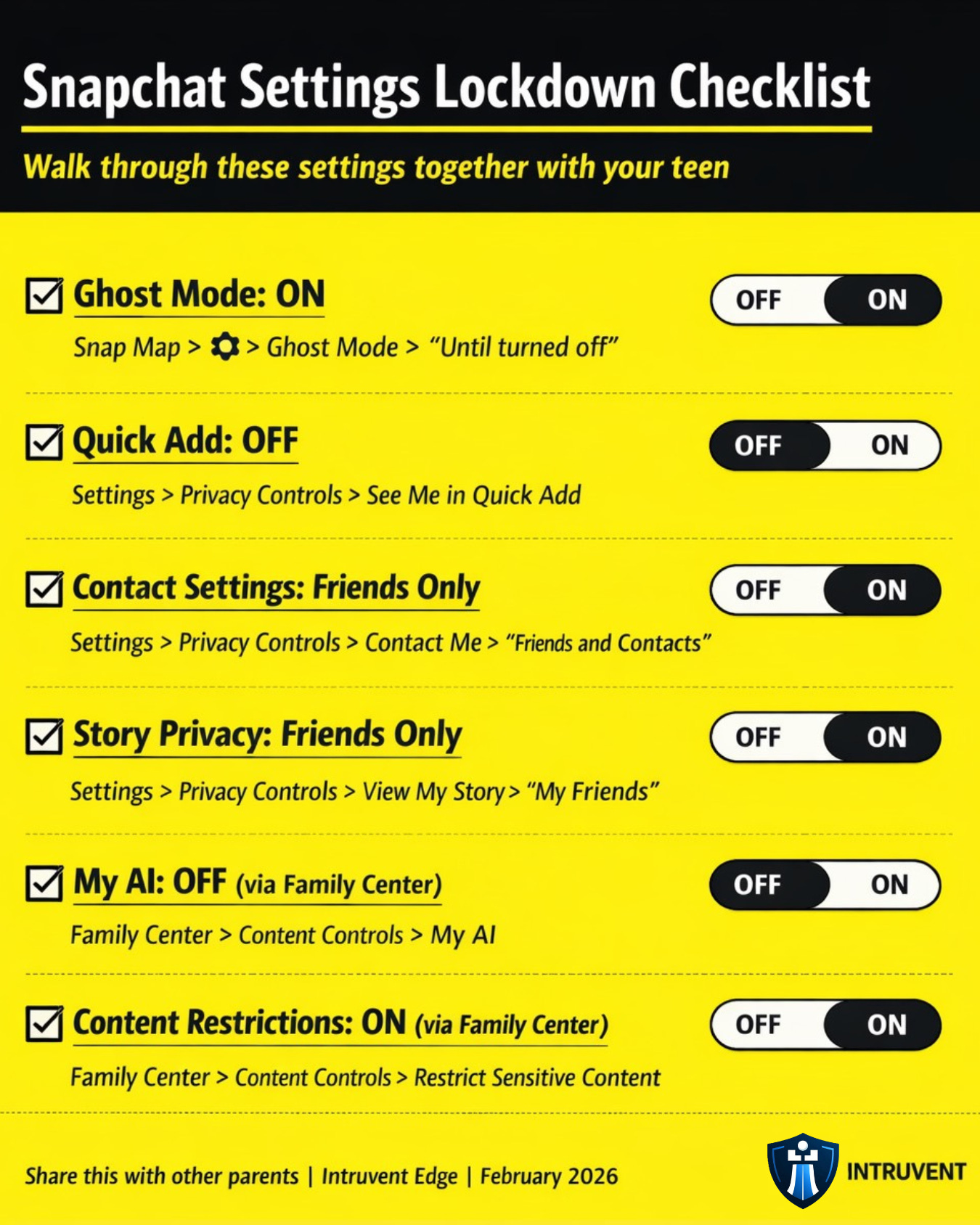
Walk through your teen’s phone together and adjust these:
***1. Ghost Mode: ON. The most important setting. Snap Map > gear icon > Ghost Mode > “Until turned off.” Hides your teen’s real-time location from everyone.
***2. Contacts: Friends Only. Should be the default for teen accounts, but verify. Settings > Privacy Controls > Contact Me > “Friends and Contacts.”
3. Quick Add: OFF. Settings > Privacy Controls > See Me in Quick Add > toggle off. Stops Snapchat from suggesting your teen’s profile to strangers.
4. Story Privacy: Friends Only. Settings > Privacy Controls > View My Story > “My Friends” or “Custom.”
5. My AI: OFF. Disable through Family Center if you have concerns about unsupervised chatbot conversations.
6. Content Restrictions: ON. Through Family Center, restrict sensitive content on Spotlight and Stories.
Supplement with Phone-Level Controls
Snapchat doesn’t offer screen time management, so use your phone’s tools:
Apple Screen Time (iPhone) lets you set daily app limits, enforce downtime, and restrict downloads. Google Family Link (Android) offers similar controls. These operate at the system level and can’t be bypassed from within Snapchat.
Have the Conversation
On disappearing messages: “Nothing online truly disappears. Screenshots and screen recordings can capture anything. Before you share something, ask yourself if you’d be okay with it showing up on a billboard.”
On strangers: “If someone you don’t know in real life adds you, don’t accept. If someone starts asking personal questions or pressuring you for photos, tell me immediately.”
On sextortion: “Criminals trick teenagers into sharing images and then blackmail them. It happens to smart kids every day. If it ever happens to you or a friend, come to me. You won’t be in trouble. The person doing it is the criminal.” Direct them to NCMEC’s CyberTipline (1-800-843-5678) or report.cybertip.org.
On streaks: “The app is designed to make you feel like you have to be on it constantly. That’s product design, not friendship. It’s okay to put it down.”
On Snap Map: “Would you walk around holding a sign with your exact address? Ghost Mode stays on.”
The Bottom Line
Social Media apps serve a purpose: They are the new norm for teen communications. Snapchat isn’t going away. Chance are that your teen’s friends are on it. And the research shows that education and supervised engagement protect kids better than blanket bans.
But Snapchat’s default settings are more permissive than most parents realize, and the platform’s parental tools still have real gaps. Set up Family Center. Enable Ghost Mode. Kill Quick Add. Then have the conversation. The 15 minutes it takes to walk through these settings together could save your family from a crisis.
Thanks for reading Intruvent Edge! This post is public so feel free to share it.
Research Sources: Snap Inc. Newsroom & Family Center Documentation, Snapchat Support (help.snapchat.com), New Mexico DOJ v. Snap Inc. (2024), NPR (Dara Kerr, 2024), TechCrunch (January 2026), Snap Inc./Western Sydney University Sextortion Research (2025), NCMEC CyberTipline Reports (2024), Thorn Sextortion Study (2025), DHS Know2Protect Campaign (2025), After Babel Platform Analysis (2025), Malwarebytes Online Safety Research (2025), Pew Research Center (2025), Nature (2025), JAMA Network Open (2024)
Last Updated: February 17, 2026